
Medical Disclaimer: This content is for informational and educational purposes only and does not constitute medical or dental advice, diagnosis, or treatment. Home remedies are not substitutes for professional dental care. Always consult your dentist and physician before making changes to your health routine. If you experience severe pain, swelling, fever, or signs of infection, seek immediate professional care.
You’ve been to your physician, run every cardiac test on the list, and still have no clear explanation for the heart palpitations you keep experiencing. Your heart health gets the full spotlight. Your mouth, though? It often gets overlooked. This scenario plays out for thousands of people every year, highlighting one of the most significant gaps in modern medicine: the disconnect between oral health and heart disease.
You may have wondered if a tooth infection can cause heart palpitations, and there is a definitive but surprising answer. The relationship between what happens in your mouth and the rest of your body is well established, and medical professionals know that tooth infections can affect heart health. Dental infections are also far more common than most people realize, especially since 90% of them produce no pain whatsoever. That reality, and the science of the connection between your mouth and your heart, is exactly what this article addresses.
What a Tooth Infection Does to Your Body
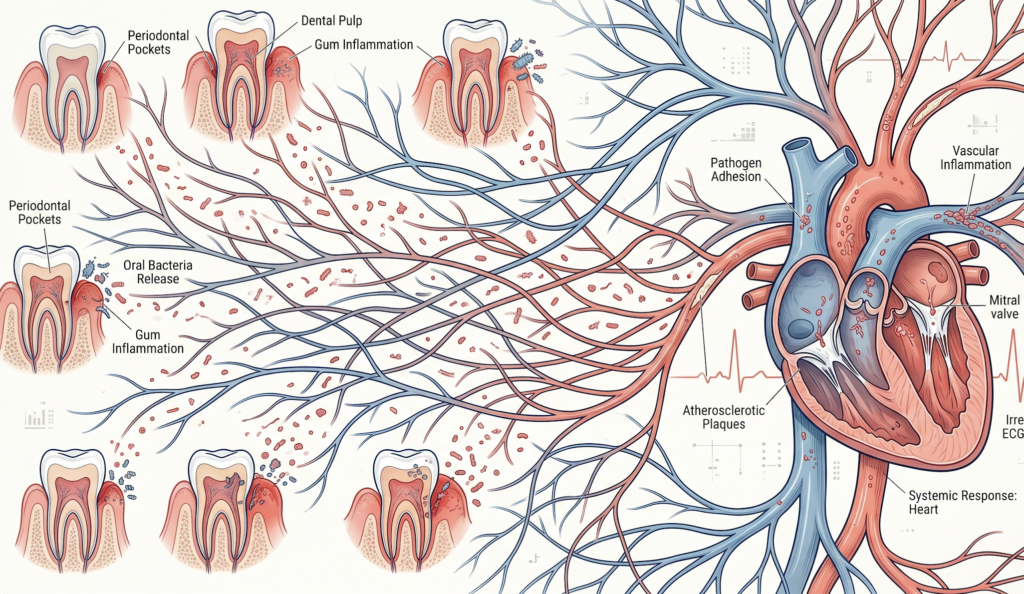
The connection between dental infections and heart symptoms starts with how bacteria travel through your body. An infection at the root of your tooth creates a portal through damaged gum tissue. Through that portal, bacteria gain direct access to your bloodstream, a process known as bacteremia.
Research confirms that once oral bacteria enter the bloodstream, they can reach distant organs, including your heart, brain, and kidneys. Oral bacteria have been identified in arterial plaque, confirming that what starts in your mouth doesn’t stay there.
Bacteria circulating throughout the body place a significant burden on the organs they contact, and your body responds to this bacterial presence through inflammation. Inflammation is one of the body’s ways of fighting an infection, but complications arise when that inflammatory response becomes chronic, sustained by an infection that never gets identified or addressed.
Here is the part that catches most people off guard. Without pressure, there is usually no pain, even when an active infection is present. Your tooth can look completely normal, feel fine, and still harbor a potentially serious infection at the root, one that quietly connects your oral health with cardiovascular complications.
How a Tooth Infection Can Lead to Heart Palpitations
A dental infection can contribute to heart palpitations through three distinct mechanisms, and they often work together:
Infective Endocarditis and Heart Rhythm
Infective endocarditis happens when bacteria from an oral infection make their way into your bloodstream and settle on your heart valves or the inner lining of your heart. A systematic review published in the International Journal of Clinical Practice examined whether acute dental infections could be connected to cardiac arrhythmia, including atrial fibrillation. The evidence is still limited, but the review included a case report describing a patient whose pain-free infection from an upper canine tooth was associated with the onset of an irregular heartbeat.
Here is what that looks like inside your body. When bacteria settle on heart valve tissue that is already damaged or vulnerable, the inflammation that follows can interfere with the electrical signals that keep your heartbeat steady. You might feel fluttering, skipping, or pounding in your chest. If you have a congenital heart condition, prior valve surgery, or existing valve damage, your risk is higher. That is why addressing a pain-free dental infection is not just about your teeth. It is about protecting your heart.
Systemic Inflammation and Your Heart Rate
Researchers at Hiroshima University studied 76 patients with cardiac disease. They found a significant correlation between periodontitis, or gum disease, and fibrosis, a form of scarring in the heart’s left atrium that can lead to an irregular heartbeat called atrial fibrillation. The researchers noted that periodontitis drives chronic, long-standing inflammation and that inflammation is directly implicated in the development of heart disease.
Both teeth and arteries accumulate plaque. They are related, and neither is healthy. Inflammatory markers circulating in the bloodstream in response to a dental infection do not stay confined to the jaw. They reach your heart, and they affect its function.
The gap between dental infections and medical training leaves most physicians completely unprepared to recognize oral infections as drivers of heart rhythm disruption. But the mouth is part of the body and the gap is not a failure of care. It is an opportunity to learn how your body’s health is intertwined from head to toe.
Stress, Pain, and the Body’s Response
When you don’t experience pain from a dental infection, it does not mean that your body is passive. Your body constantly responds to the bacterial load circulating through your bloodstream, sustaining an immune response that elevates inflammation and possibly raises your heart rate. This systemic response is one reason your tooth infection and heart palpitations can occur simultaneously, with no obvious dental symptoms to connect them. Stress works through a related hidden pathway: the same fight-or-flight response behind high blood pressure jaw clenching also tightens blood vessels, so your jaw and your numbers can move together even when the trigger is nerves rather than infection.
Not every dental infection leads to heart problems. Your cardiovascular history, the severity of the infection, and your overall immune function all shape the outcome. But untreated dental infections place a sustained inflammatory burden on your body, and the longer the source goes unidentified, the greater the risk can become.
Why Your Physician May Not Make the Connection
Physicians graduate without learning to include the mouth in their systemic evaluations. Medical school curricula have historically excluded the oral-systemic connection from training, and most physicians have never had the opportunity to learn it. The physician-dental gap is real, and it has a documented educational origin. Research from Harvard and the University of Massachusetts confirms that oral-systemic education is largely absent from medical, physician assistant, and nurse practitioner training programs.
The result is that when you present unexplained heart palpitations, your physician orders an EKG and a stress test, but never extends the examination to your teeth. A pain-free, infected molar is simply outside the diagnostic frame.
Consider this scenario. When a dental infection goes unaddressed, it can raise your blood pressure. A physician may then prescribe blood pressure medication, which is a reasonable response to the symptom. The challenge is that blood pressure medication can cause a dry mouth. Reduced saliva normally dilutes the acid produced by harmful bacteria in the mouth, so when saliva levels drop, your gum disease can worsen, continuing the unhealthy cycle. Knowing this, we can find and address the source of the problem, not just the symptoms.
Warning Signs That a Tooth Infection May Be Affecting Your Heart
Your teeth can look and feel completely fine and still harbor an active infection. It should not come as a surprise. High blood pressure, diabetes, glaucoma, and the early stages of cancer can all be present without pain. Knowing the warning signs, both dental and cardiac, helps you recognize when the two might be connected. The full list of the symptoms of a tooth infection spreading to your heart can help you act before they progress.
Systemic signs that a dental infection may be spreading include:
- Persistent fatigue or a significant drop in energy
- Fever, chills, or night sweats
- Swollen lymph nodes in the neck or jaw
- A persistent foul or metallic taste in the mouth
- Swelling in the jaw, face, or neck
- Lightheadedness or dizziness from a dental infection
These cardiac symptoms may show up alongside a dental infection:
- Heart palpitations, including fluttering, skipping, or racing sensations
- An elevated resting heart rate
- Chest discomfort or unusual pressure
- Shortness of breath not explained by activity
- Lightheadedness or near-fainting episodes
The connection between oral health and cardiovascular symptoms involves inflammatory pathways that can affect how your heart functions. If you are managing heart health concerns and experiencing any combination of these signs, bringing your dentist and physician into the same conversation is the right step.
What You Can Do Starting Today
Three steps can meaningfully reduce your risk and begin to close the gap between your dental and medical care. These are specific, evidence-based, and largely free:
1. Schedule a Complete Dental Exam.
Ask your dentist specifically to look for pain-free infections, take radiographs (X-rays), and assess your gum health in detail. A complete dental exam with X-rays is the only way to identify infections that produce no symptoms. Michelle Brummett, a Registered Nurse with a BSN, described the results of her dental extractions as life-changing, a transformation she had not anticipated from dental care. Request the exam explicitly.
2. Start an 8-to-10-minute daily home care routine.
Spend at least four minutes cleaning your teeth and four minutes cleaning between your teeth every day. For cleaning between the teeth, choose one of three methods: interproximal brushes, directed water irrigation, or flossing. Set a two-minute timer for each dental arch, two minutes for your upper teeth and two minutes for your lower teeth. Test your thoroughness with disclosing tablets, which reveal the plaque you’ve missed. This routine is completely free, and it makes a bigger difference than most people realize.
3. Tell your physician what you have learned.
At your next appointment, bring up your dental health. Share the results of your dental exam. Ask your physician directly whether a pain-free dental infection could be contributing to your heart symptoms. You can bridge the gap between physicians and dentists yourself. Your physician may not have the training to ask about your mouth, but you now have the knowledge to raise any concerns.
Can a Dental Infection Affect Your Heart Rhythm?
The cause of your heart palpitations could be a tooth infection. Your body does not respond to infections in only one place or in only one way. Bacteria traveling through the bloodstream reach every organ, including the heart, and their presence can affect how your heart functions.
The philosophy that guides everything at The Dental Medical Convergence is the same one that should guide your health decisions. We must find and address the source of any disease, not just its symptoms. Managing heart palpitations without examining the mouth means the source may never be identified. Your physician may never have had the training to look for it.
A complete dental exam with X-rays could reveal a pain-free infection that no one managing your heart health has ever thought to check for, and that single exam could change the trajectory of your cardiovascular health. For a deeper exploration of the mouth-body connection, read “Are Your Teeth Making You Sick?” by Dr. Chuck Reinertsen, available on Amazon and here at The Dental Medical Convergence.
If you or someone you know has improved or eliminated a medical issue following dental care and achieved a healthy mouth, please share your story at Stories@TheDentalMedicalConvergence.org. You could help someone else who shares the same experiences.
Frequently Asked Questions
Most people managing heart symptoms have questions their physician has not thought to ask. The FAQs below address the most common ones about the relationship between dental infections and heart health.
Can a dentist spot a dental infection that is connected to your heart symptoms?
A dentist who performs a complete dental exam with X-rays can identify pain-free tooth infections that can contribute to heart palpitations. Many infections are invisible to the patient and to the naked eye. Asking your dentist specifically to check for hidden infections and then sharing those findings with your physician opens a conversation that most medical appointments never reach.
Does cleaning your teeth more thoroughly reduce the risk of dental infections affecting your heart?
Spending eight to ten minutes once a day thoroughly cleaning your teeth makes a meaningful difference to both your oral and systemic health. Use at least four of those minutes cleaning between your teeth with interproximal brushes, directed water irrigation, or flossing. The encouraging part is that this level of care costs nothing and is available to everyone starting today.
Should you tell your cardiologist or physician about a dental infection?
Your physician manages your heart health with the information available to them, and oral health is rarely part of that picture. Bringing dental exam results to your next appointment, and asking whether a pain-free infection could be contributing, gives your physician something concrete to work with and opens a more complete conversation about what is driving your symptoms.
Are there dental conditions other than tooth infections that can affect heart rhythm?
Periodontal (gum) disease creates a sustained pathway for bacteria to enter the bloodstream through inflamed gum tissue, even without a visible abscess. That same inflammatory response can circulate systemically, placing a strain on the cardiovascular system. A complete dental exam with radiographs evaluates both root health and gum tissue, giving a full picture of what may be contributing.
How long does it take to see improvements after a dental infection is addressed?
In Dr. Chuck Reinertsen’s clinical experience, patients have seen meaningful improvements within weeks of addressing a pain-free infection. In one case, a patient no longer needed blood pressure medication three weeks after a pain-free, infected tooth was carefully removed.
Please Share This. Someone You Know Needs It.
If you know someone managing unexplained heart palpitations or a cardiac condition, share this article with them. The connection between a pain-free dental infection and the heart is something most physicians were never trained to raise, and that awareness could change their life. More people need to learn and understand that dental infections have many significant medical consequences.
To go deeper on the mouth-body connection, read Are Your Teeth Making You Sick? by Dr. Chuck Reinertsen. If you or someone you know has improved or eliminated a medical issue following dental care and achieving a healthy mouth, please share your story at Stories@TheDentalMedicalConvergence.org