
Medical Disclaimer: This content is for informational and educational purposes only and does not constitute medical or dental advice, diagnosis, or treatment. Home remedies are not substitutes for professional dental care. Always consult your dentist and physician before making changes to your health routine. If you experience severe pain, swelling, fever, or signs of infection, seek immediate professional care.
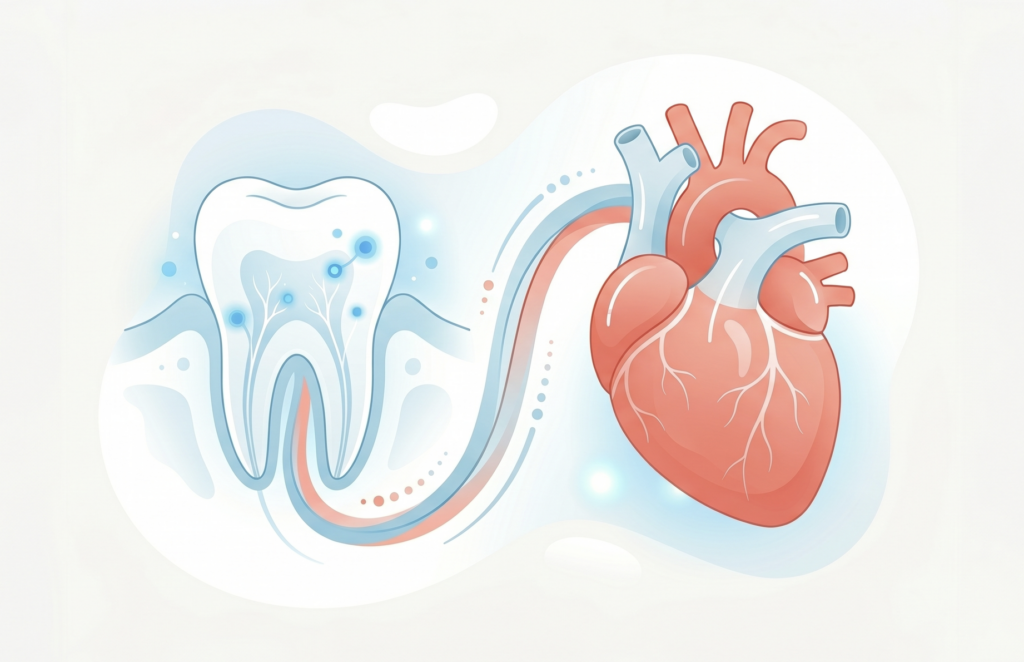
If a tooth doesn’t hurt, it’s easy to assume everything is fine. The more important reality is that a tooth infection rarely stays in your mouth. Bacteria from a pain-free dental infection can enter the bloodstream, travel to the heart, and trigger infective endocarditis, a bacterial infection of the heart’s inner lining. In fact, 90% of dental infections have no pain, just as conditions like diabetes and high blood pressure also go symptom-free for years before detection. That silent progression is different from the sudden heart attack jaw pain location many people mistake for a toothache in the moment, so it helps to know both patterns. The dangers of untreated tooth infections explains what can happen when these infections go unaddressed.
The connection between oral health and heart disease is real, and recognizing the symptoms of tooth infection spreading to your heart early can be lifesaving. This article walks you through what to watch for and when to act.
How a Tooth Infection Reaches Your Heart
Your mouth is the front door to your body, and 99% of what enters your body passes through it. That same connection works in both directions. Bacteria from a dental infection can travel from your mouth into the rest of your body through the bloodstream. When tissue around a tooth or below the gumline breaks down, bacteria enter the bloodstream through bacteremia.
What creates most tooth pain is pressure inside a confined space. No pressure means you won’t feel any pain, even when there’s an active infection spreading through the surrounding bone. A tooth can look and feel completely fine on the surface and still carry an active infection, which is also how an infected root canal can quietly raise your blood pressure long before you notice anything is wrong. On the occasions a tooth does hurt, that pain carries its own blood pressure risk, worth a closer look in can tooth pain cause high blood pressure.
Time matters in a way that’s easy to underestimate. A pain-free dental infection can release bacteria into your bloodstream for months or even years before any cardiac symptom appears. Each pulse of bacteria is small, but the cumulative exposure is what gives the bacteria the chance to attach to a heart valve or settle into inflamed tissue, the process that can lead to a dental heart attack. The longer the source goes untreated, the more opportunity the bacteria have. The earlier it’s identified, the lower the cardiac risk.
Waiting for pain before seeking care can delay detection of a serious problem. A comprehensive dental examination with radiographs (X-rays) gives you a clear picture of what is happening beneath the surface, even when a tooth looks and feels fine.
Early Warning Signs to Watch For
Before bacteria reach your heart, your body produces recognizable warning signs, like fever, fatigue, and swollen lymph nodes, that are easy to mistake for the flu or general exhaustion. Signs that you might have a spreading dental abscess include persistent fever, swollen or tender lymph nodes, and a foul taste in the mouth.
Fatigue is another early signal, and often appears before any cardiac symptoms develop. If you’ve been experiencing extreme fatigue that you can’t explain, a dental examination is a reasonable and low-cost place to start.
These symptoms often have no obvious connection to your mouth, which is part of what makes them easy to miss. If your physician has already ruled out respiratory or viral causes, ask whether they considered a dental source. Many physicians weren’t trained to include the mouth in their examinations, and you can help close that gap by raising the question yourself.
The symptoms of a spreading tooth infection tend to follow a clear progression as it moves from oral and systemic signs to cardiac ones. Knowing where you are on that spectrum helps you decide how urgently to act.
Tooth Infection Symptoms vs. Cardiac Warning Signs |
|
| Tooth Infection Spreading to Heart Symptoms (Oral/Systemic) | Cardiac Warning Signs |
| Persistent low-grade fever (100-101°F) | Heart palpitations or irregular heartbeat |
| Unexplained chills | Chest discomfort or pressure |
| Swollen or tender lymph nodes in the neck or jaw | Shortness of breath |
| Foul taste in the mouth | New or worsening heart murmur |
| Extreme fatigue with no clear cause | Lightheadedness or dizziness |
| Toothache or facial swelling | High fever above 103°F with confusion |
Who is Most at Risk?
Some people face a higher risk when a dental infection reaches the bloodstream. If you have a history of heart valve repair or replacement, congenital heart defects, or a previous episode of infective endocarditis, your cardiac tissue is more vulnerable to bacterial colonization. The same is true if you live with diabetes, an autoimmune condition, or a weakened immune system.
Age plays a role, too. Adults over 65 are more likely to carry gum disease and more likely to have the kind of accumulated cardiovascular wear that makes bacterial seeding dangerous. None of these factors means a tooth infection is guaranteed to reach your heart. They mean the margin for waiting is smaller, and the case for a thorough dental examination is stronger.
If you recognize any symptoms in the right column, contact your physician the same day. The cardiac warning signs do not resolve on their own, and the sooner you identify the source, the better your outcome.
Symptoms a Dental Infection Has Reached Your Heart
When oral bacteria reach the heart, they tend to settle on tissue that’s already vulnerable, a previously damaged valve, an area of inflammation, or a small irregularity in the heart’s lining. As the bacteria colonize that tissue, the immune response and the bacterial growth together interfere with how the heart pumps and how its valves seal. That’s where the palpitations, the murmur, and the shortness of breath come from, and it’s also why knowing which teeth hurt during heart attack episodes can help you connect oral pain to cardiac risk. The symptoms you feel are the downstream effect of bacterial colonization inside the heart itself.
A review published in Frontiers of Oral Health found substantial evidence linking the oral microbiome to the development and progression of infective endocarditis. Another study from Kobe University Hospital found that patients whose infective endocarditis was caused by oral bacteria had significantly more teeth requiring extraction than patients whose infection came from other sources in their bodies. The pattern suggests that the worse the oral health, the heavier the bacterial load reaching the heart.
Antibiotics can reduce bacterial load and calm the immediate threat, but they won’t resolve the source. The infection will return unless your dentist and physician work together to identify and address the underlying cause.
Take Action Before Your Symptoms Progress
When the mouth and the heart are treated as separate systems, infections can slip through undetected. That’s the gap integrated dental-medical care closes, and the gap you can start closing today.
Schedule a comprehensive dental examination with your dentist, including radiographs, and ask your dentist to share the findings with your physician. If you’ve been managing unexplained cardiac symptoms, ask your physician whether a dental workup belongs in your evaluation. While you’re waiting for that appointment, spend 8 to 10 minutes a day thoroughly cleaning your teeth. That’s 4 minutes cleaning your top arch and 4 minutes cleaning your bottom arch with a toothbrush, dedicated time cleaning between the teeth with interproximal brushes, directed water irrigation, or floss.
For years, patients have wondered why their medications stopped working, why fatigue wouldn’t lift, and why the antibiotics kept failing. The real answer was right under your nose. Literally.
If you want to go deeper into the mouth-body connection, Dr. Reinertsen’s book Are Your Teeth Making You Sick? explores it in full.
If you or someone you know has improved or eliminated a medical issue following dental care, please share your story at Stories@TheDentalMedicalConvergence.org.